


The Lodger and the Landlady
Updated: Jan 26, 2024
In the Referee of 24 August 1913, George Sims told a story about a letter he had received some years earlier, which he referred to as "an astounding document" existing among his papers (which story is reproduced in full by Jonathan Hainsworth on JTR Forums here). Apparently recalling the contents of that letter from memory, the essentials of the story as told by Sims were that, during the time of the Whitechapel murders, a nocturnal medical student had taken lodgings with a married couple but, on 29 September 1888, was given notice to quit after paying unwanted attention to their niece. That night, the lodger went out after 10pm and returned at 3am in a state of excitement, covered in scratches, claiming to have been attacked. When the landlady snuck a look inside the black bag he always carried around with him she found a long knife. The lodger disappeared later that day and, upon hearing the news of the double event, the landlady's husband reported the man to the police but he could never be traced.
From the way that Sims told this story in his Referee column, it wasn't entirely clear if he was saying that this lodger was the same person as the lodger from Blackheath who he understood was the real Jack the Ripper and who was obviously Montague Druitt. Although Sims explained that when he leant of the unnamed Druitt's suicide in the Thames he put away the landlady's letter because there was no useful purpose in following up any other clue, this in itself doesn't mean that the landlady's lodger wasn't Montague Druitt because Sims may not have known at the time he read her letter any details about Druitt which would have enabled him to be identified or eliminated as the lodger.
It's certainly hard to understand why Sims bothered to tell the story in such great detail and call the landlady's letter 'an astounding document' if the lodger of the story was nothing more than an innocent man who happened to carry a knife and had been beaten up on the night of the double event. Perhaps Sims was merely trying to convey that he had heard a story of Jack the Ripper being a lodger prior to publication of the Marie Belloc Lowndes story, 'The Lodger'. Perhaps he also wanted to break the news that the real Jack the Ripper had been a lodger.
One thing is for sure though. The lodger in the story could not possibly have been Montague Druitt and, furthermore, there is good reason to think that Sims' entire story was bullshit.
Two years earlier, Sims had told what must have been the same story about the lodger in an article entitled 'Adventures of a Journalist' published in the Yarmouth Independent of 25 February 1911.

In that article, he said he had been told this story about the lodger three years earlier which would suggest 1908 but, as he might have written the piece in 1910, could equally be 1907, and this is more likely because he said it happened after he had written on the subject of Jack the Ripper which he did in 1907 but not in 1908.
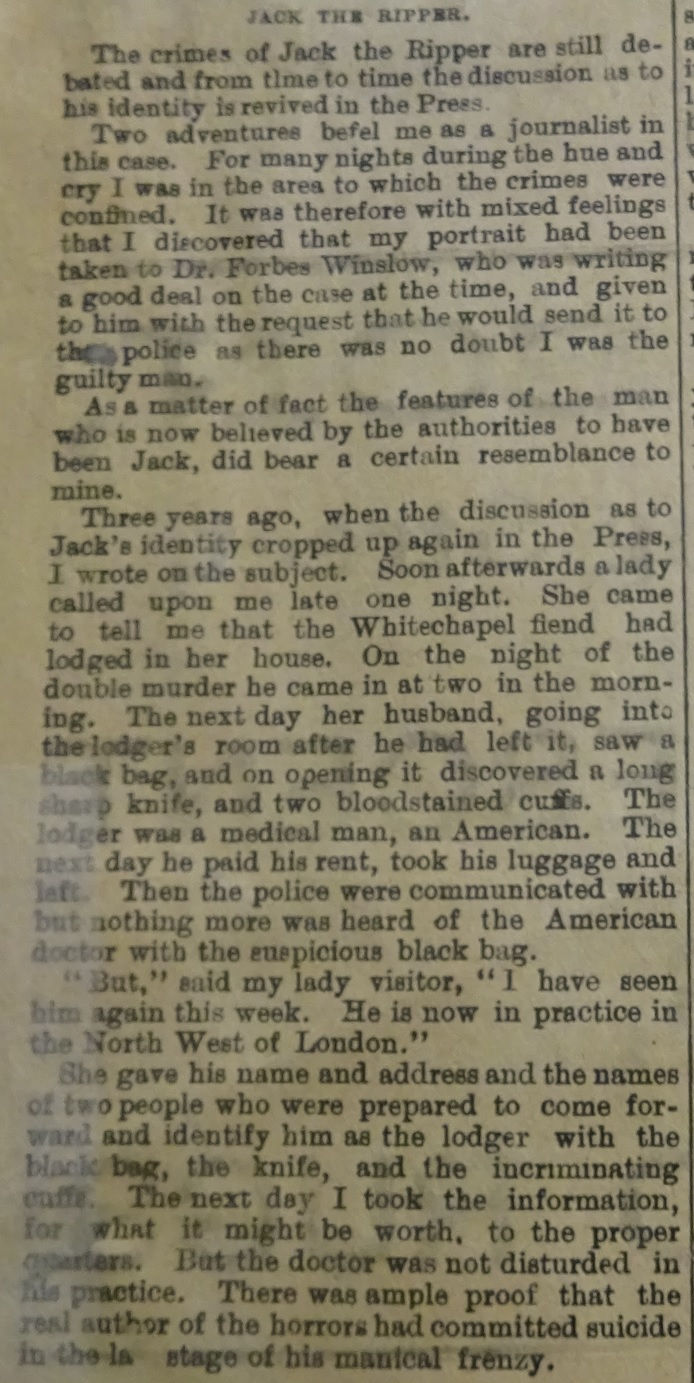
As can be seen, this story involved a lodger who was 'a medical man' who was out on the night of the double event but came in at 2am and whose black bag, upon being searched by the landlady's husband, contained 'a sharp knife, and two bloodstained cuffs' but the next day the lodger paid his rent and left.
While this is not identical to the 1913 story because the lodger of that story returned at 3am not 2am, his bag was searched by the landlady not the landlord and there was no mention of any bloodstained cuffs, plus this lodger paid his rent before leaving on his own volition whereas the other lodger had fled after having been given two weeks' notice, it is nevertheless way too similar to allow for it to be a different story.
But there are some critical details revealed in this version of the story which prove that it can't be Druitt. Firstly, the lodger was an American. Indeed, Mike Hawley has suggested for this reason that it was Tumblety. Second, the lodger was still alive and working as a doctor in the North West of London in about 1907 or 1908, because the landlady had seen him, something which not only rules out Druitt but Tumblety too.
What is particularly different about this story is that, far from having received a letter, the lady in question, says Sims, 'called on me one night'. The story she told to Sims was, therefore, told to him in person. There was no letter. No 'astounding document'.
This shows how unreliable Sims is. We have a story which has been told differently in two different tellings within a few years of each other and for which different accounts have been given as to how Sims came to hear of it. Even worse, at the end of the story, Sims writes:
'She gave his name and address and the names of two people who were prepared to come forward and identify him as the lodger with the black bag, the knife and the incriminating cuffs. The next day I took the information, for what it might be worth, to the proper quarters'.
So Sims, on his own account, was sufficiently interested in the story in 1907 to report to the police that Jack the Ripper might have been an American doctor still alive and in practice in North West London! This was despite the fact that he had written in two articles during 1907 that the Ripper had committed suicide by drowning in the Thames (and he had been saying this since 1899). Why, therefore, he reported the living American doctor to the police as a potential Jack the Ripper suspect (or at least claimed to have done so) is hard to fathom.
Perhaps he was told by the police that the American doctor could not be Jack the Ripper because his identity was already known and this was the first time he got official confirmation that Druitt was the killer. Hence he concludes the story by saying:
'But the doctor was not disturbed in his practice. There was ample proof that the real author of the horrors had committed suicide in the last stage of his manical frenzy'.
While it's not impossible that he was told some sort of story by a landlady, the fact that the details changed so dramatically over the next couple of years places a question mark over the veracity of the story.
One thing is for sure though. That lodger, by being American and still alive in about 1907, could not possibly have been Druitt.
LORD ORSAM
30 September 2023


Excellent summing up and analysis David.